



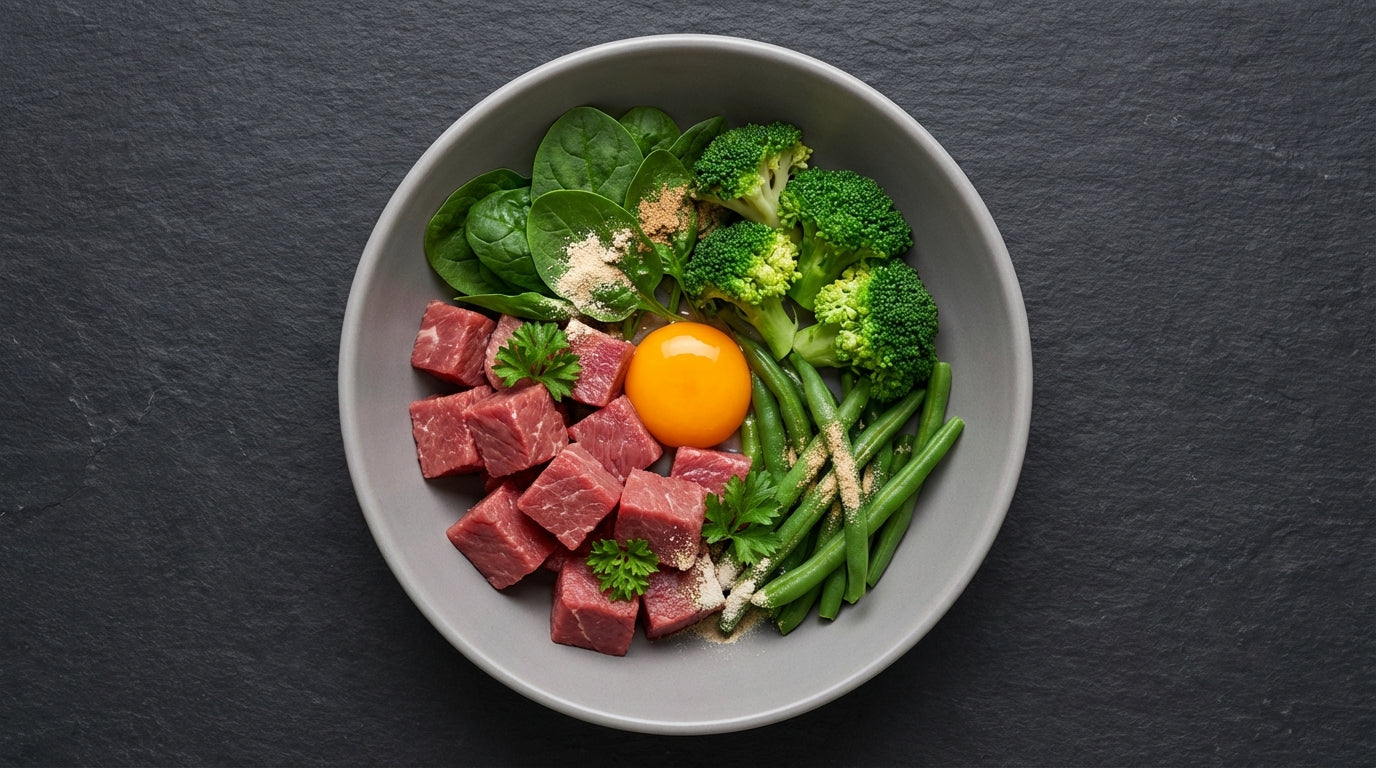
You're doing a great thing. By choosing to feed a raw diet, you've decided to give your dog food in its most natural state. But here's a question the BARF community doesn't always ask: is it complete?
A wolf eats the *entire* animal—fur, glands, stomach contents and all. A bowl of chicken wings and beef mince is not the same. It's dangerously easy to miss a few key nutrients that can cause long-term, silent damage.
Table of Contents
- Check #1: Iodine (Thyroid Fuel)
- Check #2: Manganese (Ligament Strength)
- Check #3: Vitamin E (The Body's Protector)
- Check #4: The Omega-3 Balance
- Your Nutritional Insurance Policy
Check #1: Iodine (Thyroid Fuel)
The Problem: Muscle meat, organs, and bones contain almost no Iodine. This mineral is the fuel for your dog's thyroid gland, which acts as the 'engine' for their entire metabolism. An iodine deficiency leads to hypothyroidism, causing weight gain, lethargy, and skin issues.
The Fix: Add a natural source of iodine. A pinch of pure, tested Kelp (Brown Algae) powder a few times a week is all that's needed.

Check #2: Manganese (Ligament Strength)
The Problem: This is the 'forgotten' mineral. Manganese is absolutely critical for building strong ligaments and connective tissue. It's found in things a wolf would eat—fur, feathers, and soil. It is virtually absent in muscle meat.
A long-term manganese deficiency is a risk factor for devastating injuries like torn cruciate ligaments (the canine ACL).
The Fix: Don't rely on meat. A potent source is Green Lipped Mussel, which naturally contains manganese in a highly absorbable form.
Check #3: Vitamin E (The Body's Protector)
The Problem: Raw diets are often high in fat. When the body metabolises fat, it creates oxidative stress. Vitamin E is a powerful fat-soluble antioxidant that protects cell membranes from this damage. Without it, the 'healthy' fats in your dog's diet can actually cause cellular 'rust'.
The Fix: A natural source of Vitamin E is essential. This is often supplemented directly or found in whole-food sources.
Check #4: The Omega-3 Balance
The Problem: Grain-fed beef and chicken are extremely high in pro-inflammatory Omega-6 fatty acids. A wild diet would be balanced by Omega-3s from fish or wild game. A BARF diet of only farmed meat creates a state of chronic, low-grade inflammation.
The Fix: You MUST add a potent source of anti-inflammatory Omega-3. Antarctic Krill Meal is a perfect choice, as its phospholipid-bound Omega-3s are more effective than fish oil, and it's free from heavy metal contamination.
Your Nutritional Insurance Policy
Manually adding all these nutrients can be complex and expensive.
That's why a comprehensive 'base mix' can be the perfect "nutritional insurance policy" for a BARF diet. Our Senso Balance Blend was formulated with raw feeders in mind. It contains:
- Kelp for Iodine.
- Green Lipped Mussel for Manganese.
- Krill for balanced Omega-3s.
- A full spectrum of vitamins, including Vitamin E.
It fills the gaps, so you can feed raw with confidence.
Don't Guess. Complete.
Take your raw feeding to the next level. Ensure your dog's diet is not just raw, but also truly complete.
Scientific Sources
- PMC: Nutritional Deficiencies in Commercial Raw Diets
- AVMA Journals: Evaluation of Nutrient Deficiencies in Homemade Diets


